Mycotoxin Management Solutions

What are mycotoxins?

Mycotoxins are highly toxic secondary metabolic products of moulds. Mycotoxin producing moulds damage crops, which can cause high economic losses, at all levels of food and feed production.

Moreover, many of the mycotoxins have negative health effects; causing disease or even death in the humans and animals that consume contaminated food or feed products. Currently, there are more than 500 known mycotoxins. Those of most concern can be divided into six major categories: aflatoxins, trichothecenes, fumonisins, zearalenone, ochratoxins, and ergot alkaloids.

The fungi that produce them can be split into the following two groups: field fungi that produce mycotoxins in crops before harvest (pre-harvest) and storage fungi that produce mycotoxins mainly after harvest (post-harvest). Fusarium and Claviceps moulds are mainly considered to be field fungi; whilst Aspergillus and Penicillium moulds are often referred storage fungi.

I want to be contacted by an expert
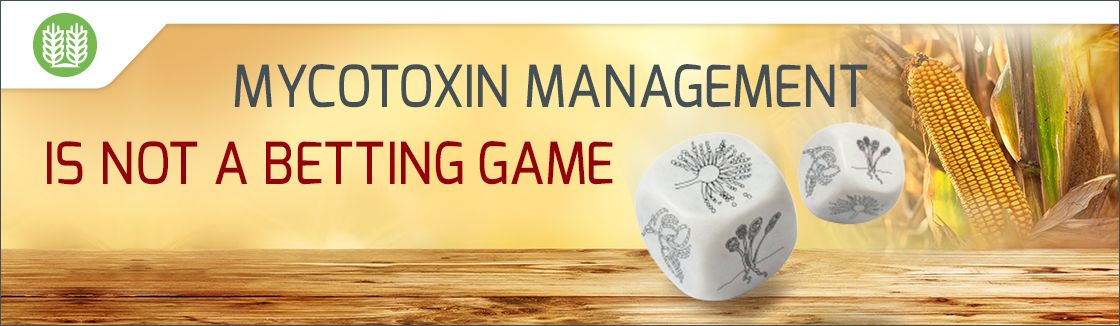
Text: Mycotoxin Management is Nort a Betting Game, with dice and agricultural products.
Subscribe to receive mycotoxin alerts

Helpful resources

Top line
MycoPedia

MycoPedia

Tag Separator
Booklet
Top line
Close the door to mycotoxins to maximize the reproductive performance of sows and boars

Close the door to mycotoxins to maximize the reproductive performance of sows and boars

Tag Separator
Technical article
Top line
A high mycotoxin contamination is expected in wheat, increasing risk for piglets

A high mycotoxin contamination is expected in wheat, increasing risk for piglets

Tag Separator
Technical article

How Mycotoxins effect all species

Mycotoxin symptoms in pigs

Pigs are generally the most sensitive livestock species to mycotoxins. The earliest indication of aflatoxin contamination in the diet is reduced feed intake. Aflatoxins suppress the immune system, and depending on the level of exposure, clinical signs can range from poor growth performance to hepatic damage and, in severe cases, death.

Among the trichothecenes, deoxynivalenol (DON) and T-2 toxin are the most significant for the swine industry. T-2 toxin markedly reduces feed intake, while DON also suppresses feed consumption, impairs growth, and can induce vomiting.

Ochratoxins exhibit both hepatotoxic and nephrotoxic effects, along with other chronic toxicities. Pigs exposed to ochratoxin often show reduced growth, decreased weight gain, and renal lesions.

Zearalenone primarily exerts estrogenic effects in pigs. In pregnant sows, it increases the incidence of abortions and stillbirths. In non-pregnant animals, zearalenone-contaminated feed can cause vulvar swelling and reddening, false estrus, and pseudopregnancy.

Fumonisins target the liver, lungs, and pancreas, and in pigs, they can lead to porcine pulmonary edema.

Silhouette of a pig facing right, with snout down.

Mycotoxin Management: identify your risk and adopt the best strategy

From the crop to the feed, mycotoxin production is a cumulative process. It is controlled by several factors, the most important being climatic conditions and the agronomic practices during crop growth. 

However, each mycotoxin has its own model of development, meaning that every year the crops are contaminated differently, both in terms of quantity and mycotoxin type. The risk is therefore ever-present, and ever-changing. 

A holistic approach is needed to identify the risk and adopt the best strategy. Customers across the globe have been successfully working with our mycotoxin management program for decades. We offer you an integral approach by going through all the steps of the chain. 

Our MycoMan range of services allow you to identify your risks – from the raw materials to the animals. 

Our solutions Unike® Plus, Unike® and Toxy-Nil® are protecting your animal. Providing cost effective to a maximal protection, against a broad spectrum of mycotoxin.

Mycotoxin Management: identify your risk and adopt the best strategy

Mycotoxin Management by Adisseo

From the crop to the feed, mycotoxin production is a cumulative process. It is controlled by several factors, the most important being climatic conditions and the agronomic practices during crop growth. However, each mycotoxin has its own model of development, meaning that every year the crops are contaminated differently, both in terms of quantity and mycotoxin type. The risk is therefore ever-present, and ever-changing.

A holistic approach is needed to identify the risk and adopt the best strategy. Customers across the globe have been successfully working with our mycotoxin management program for decades. We offer you an integral approach by going through all the steps of the chain.

Our MycoMan range of services allow you to identify your risks – from the raw materials to the animals.

Our solutions Unike Plus, Unike and Toxy-Nil are protecting your animal. Providing cost effective to a maximal protection, against a broad spectrum of mycotoxin.

decoration

Related solutions

Product names and availability may vary by region, please contact your local Adisseo representative for more information.

Unike
Unike is a powerful protection against broad-spectrum mycotoxin contamination.
See more
SwinePoultry
Separator
Unike Plus
Maximum protection against broad-spectrum mycotoxin contamination and their consequences on the animals.
See more
PoultrySwineRuminants
Separator
Toxy-Nil
Toxy-Nil is a reliable protection against moderate-level mycotoxin contamination.
See more
PoultryRuminants
Separator
MYCOMAN
Turns mycotoxin risk data into clear decisions from crop prediction to feed screening and feedmill assessment.
See more

I want to know more about Mycotoxin management solutions

* required fields
Please select

The information collected in this form is transmitted to the appropriate Adisseo department to manage your comments and requests for information on the site. For more information, please refer to the information notice.

Adisseo
© 2025 Adisseo.

You are in Europe region